QGIS Users Around the World
One of the difficult things to track in the open source world is the number of people who actually use your software. In the proprietary commercial world you have licenses, invoices, and so forth. In the case of QGIS, we can track the total number of downloads from qgis.org, but this doesn’t represent the total installed base. It is impossible to accurately determine the actual number of people using QGIS, but we can get an approximation of the number and where they are in the world.
The analysis was done using the log files from the QGIS contributed repository:
-
The IP address of each entry that retrieved the plugin list from the server represents one or more users—these IPs were collected into a unique list
-
Using a Python script, each IP address in the log was geocoded to get the approximate latitude and longitude of the user
-
The IP address, country, latitude, and longitude were written to a CSV file
-
The CSV file was converted to a Spatialite layer to create the map of users
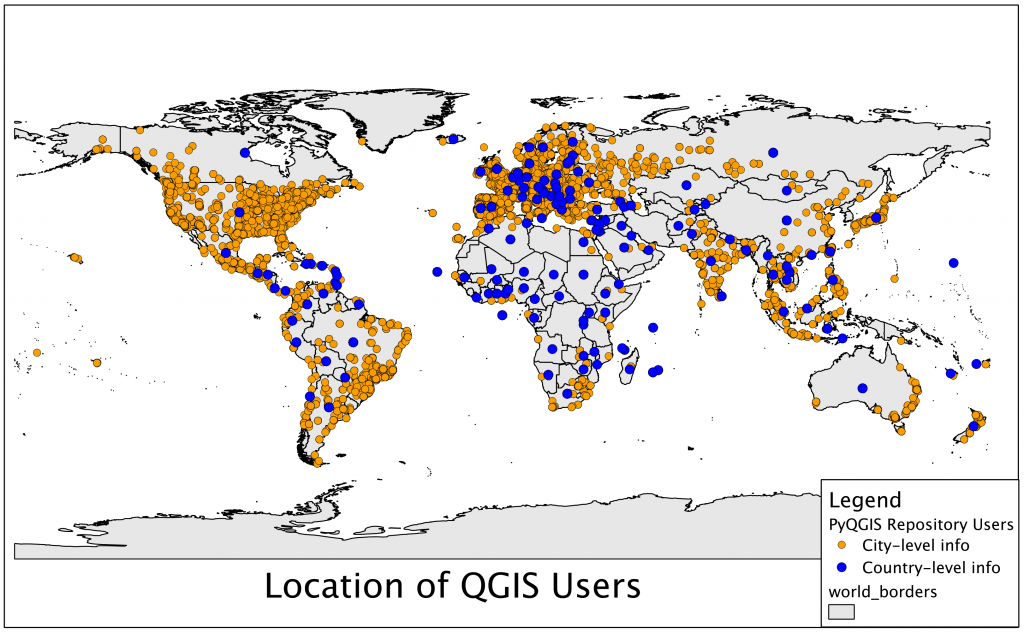
The map represents 35,603 unique IP addresses of users that accessed the repository between October 23, 2011 and December 17, 2011.
The geocoding process varies in precision—some IPs are located to the city level while others only return a general location for the country.
Some assumptions and observations:
-
Most (maybe all) users make use of Python plugins and therefore access the contributed repository at some point
-
Country-level points (blue) on the map represent more than one user
-
Some points represent organizations that use a single IP for all users accessing the Internet. These points will represent more than one user
-
Some users may access the repository from more than one IP address
So how many people use QGIS? At the very minimum, 35,000. We know that the downloads of just the Windows version exceeded 100,000. Given that there are 7,183 IP addresses that are generalized to a country location, we can safely assume that the number of actual users is much higher than that.
Considering the number of points that represent an organization and those that represent a country location, I think we can safely assume that the number of QGIS users easily exceeds 100,000 worldwide.